
After having audited both protocols, it'stime to dissect the most important difference between both:
UniV3: Concentrated Liquidity and Ranges
In UniV3, liquidityproviders (LPs) can allocate their funds within specific price ranges. Thismodel allows for what's known as "concentrated liquidity." Here, LPshave the flexibility to target their liquidity provision to the price levelsthey expect to be most active, enhancing capital efficiency.
The flip side, is that eachprice range operates akin to a mini Uniswap V2 pool, leading to potentialslippage within that range during a swap.
This slippage occursbecause, within a given range, the price can shift due to the trade's impact onthe supply and demand dynamics of the tokens involved.
Larger trades may spanmultiple ranges, impacting the price incrementally as they consume liquidityfrom one range to the next. But inherently a swap is always executed on theactive range and within each range, slippage will be present, similarly as we knowit from UniswapV2.
Trader Joe: Liquidity Bins
Trader Joe introduces aunique take on concentrated liquidity by organizing liquidity into discretebins rather than continuous ranges.
Each bin represents aspecific price point, and LPs can choose to provide liquidity directly to thesebins. This approach simplifies the process for LPs, as they don't have toselect a price range but instead choose specific price points to support. Investorscan therefore provide liquidity only to one single bin or multiple bins.
The critical advantage hereis the reduction in slippage for swaps.
When a swap is executed, itcan fully consume the liquidity available at a particular bin's price, ensuringthe swapper gets a consistent price for as much of the swap as that bin cansupport.
If the swap size exceedsthe liquidity in one bin, it moves to the next available bin, continuing untilthe swap amount is fulfilled. This sequential consumption of liquidity binsensures that slippage is minimized, as each portion of the swap is executed ata known and fixed price.
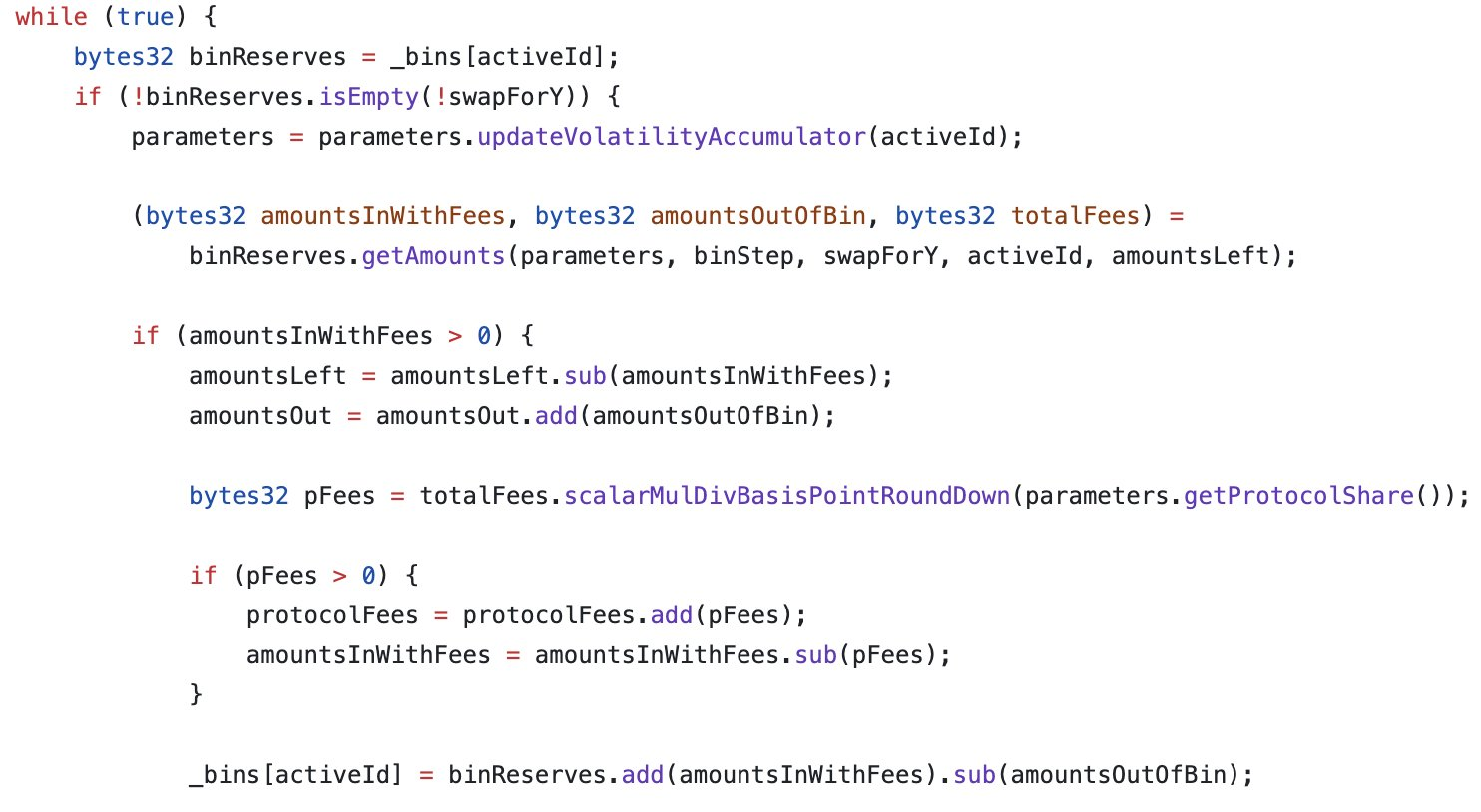
As you can see, thegetAmounts function uses the current activeId for the amount calculation, whichis simply the current price of the bin.
The difference inapproaches between UniV3 and Trader Joe fundamentally impacts swaps:
The method build by TraderJoe can offer more predictable pricing, especially beneficial for large swapsthat might otherwise experience significant slippage in a range-based systemlike UniV3's.
Both systems representinnovative attempts to solve the liquidity and efficiency challenges inherentin decentralized trading platforms. The choice between them will depend on thespecific needs and strategies of both liquidity providers and those looking toswap assets.