
In Solidity, a pragma is a directive thatprovides instructions to the compiler regarding how to process the sourcecode. Pragma Solidity is shorthand for“Pragmatic Information for Solidity.” and It specifies the compiler version tobe used to compile a contract. While the pragma version doesn't directlyinfluence the compiler's version, it prompts the compiler to verifycompatibility, generating an error if a mismatch occurs. This verificationprocess is crucial because even minor differences in compiler versions canimpact the behavior of a contract.
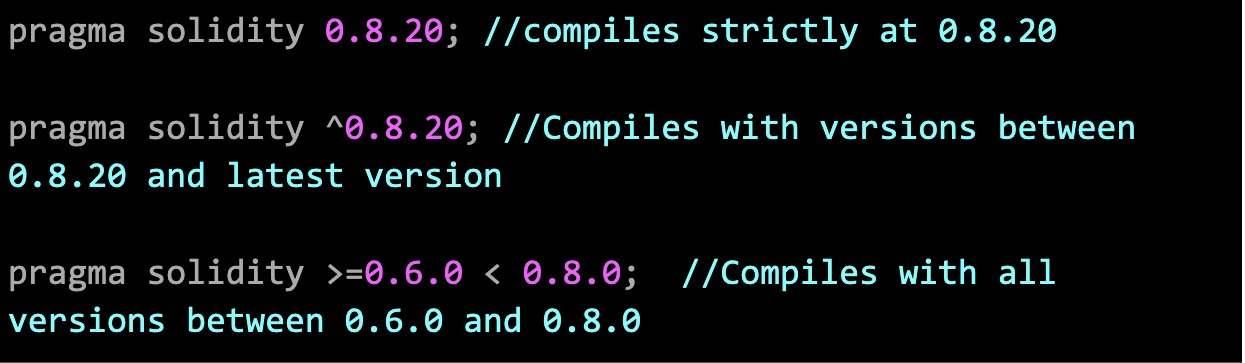
The Solidity pragma is specific to eachsource file, requiring every Solidity file to define this directive to informthe compiler of the Solidity version used in the code. This includes importedlibraries as well. There are different methods to define the pragma version.One option is to use a floating pragma, which indicates a range of acceptablecompiler versions for compilation. Alternatively, a strict pragma can beemployed, fixing the compiler version explicitly.
A floating pragma is a pragma statementthat doesn't pinpoint a precise compiler version but instead delineates a rangeof compiler versions acceptable for compilation. I.e. pragma solidity ^0.8.0;
pragma solidity 0.8.20; is a strict pragma.
pragma solidity ^0.8.20; is a floatingpragma.
pragma solidity >=0.6.0 <0.8.20 is arange pragma.
The ^ symbol in Example 2 indicates thatthe code should be compiled using a compiler version compatible with 0.8.20 andabove but below 0.9.0 (if it exists).
Sticking to a single compiler version iscommonly regarded as the best approach. Employing a floating pragma could leadto inadvertent deployment of contracts with outdated or problematic compilerversions, potentially introducing bugs and compromising the security of yoursmart contracts.
Backward Incompatibility: Newer compilerversions might introduce breaking changes or deprecate certain features, whichcould cause your existing code to behave differently or become invalid whencompiled with a newer compiler version. This can lead to unexpected behavior orvulnerabilities in your smart contracts.
Unintentional Adoption of ExperimentalFeatures: Newer compiler versions may introduce experimental features orchanges in language semantics. By floating the pragma, developers mayunintentionally adopt these features, which could have security implications ifthey are not fully understood or properly vetted.
Security Patch Delays: While newer compilerversions may include security patches and improvements, relying on a floatingpragma means that your code might not automatically benefit from these patchesuntil you explicitly update the pragma directive and recompile your contracts.