
https://hacken.io/discover/front-running/
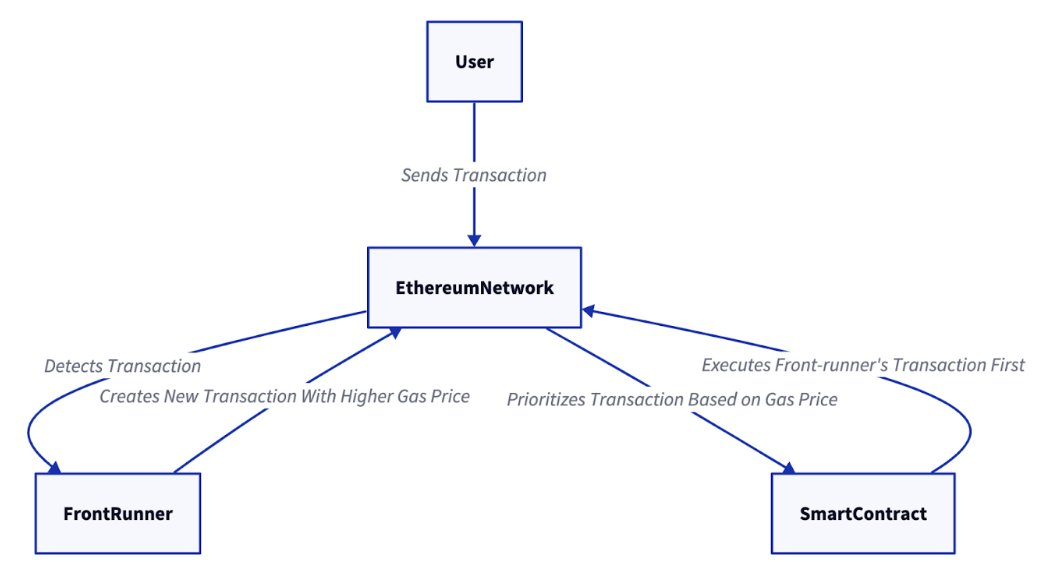
This vulnerability is not a result offaulty programming but rather exploits the way transactions are sequenced andadded into a block from the 'mempool.' It relies on the lack of transaction confidentiality and the miner'sability to randomly order and prioritize transactions. An attacker can watchthe transaction pool and send a transaction, have it included in a block beforethe original transaction. This mechanism can be abused in stealing requests,price manipulation, and transaction blocking.
Imagine there's a highly anticipated eventwith limited ticket availability, and tickets are sold through a decentralizedticketing platform on the blockchain. Users can submit transactions to purchasetickets, but due to the high demand, there's a risk of front-running attacks.
User A's Purchase Attempt: User A decidesto purchase tickets for the event and submits a transaction to the ticketingsmart contract. However, before their transaction is confirmed, an attackerobserves their transaction pending in the mempool (waiting area for unconfirmedtransactions).
Attacker's Displacement: The attackerquickly creates and broadcasts a new transaction with a higher gas fee topurchase the same tickets before User A's transaction gets confirmed. By doingso, the attacker displaces User A's transaction from being included in the nextblock.
Purchase by Attacker: Miners prioritize theattacker's transaction due to the higher gas fee, allowing them to successfullypurchase the desired tickets before User A's transaction is processed.
Outcome for User A: Since User A'stransaction was displaced by the attacker's transaction, their attempt topurchase tickets fails. Even if User A had submitted their transaction earlier,the attacker's manipulation of gas fees effectively bypasses the fairness ofthe transaction order.
In suppression attacks, attackers exploitthe congestion of the blockchain network by flooding it with a large number oftransactions, all with significantly higher gas prices. This flood oftransactions forms what is known as a "suppression cluster." The aimof this tactic is to overwhelm the network with high-priority transactions,effectively suppressing the victim's transaction.
Volume of Transactions: Attackers create abarrage of transactions, flooding the network with a large volume oftransactions.
Higher Gas Prices: Each transaction in thesuppression cluster includes a significantly higher gas price compared tonormal transactions.
Blocking Victim's Transaction: Due to theoverwhelming number of high-priority transactions in the suppression cluster,the victim's transaction struggles to find space in the same block. Minersprioritize transactions with higher gas prices, so the victim's transaction maybe delayed or pushed out of the current block altogether.
Insertion Approach in Front-running Attacks
In insertion attacks, attackers employ amore sophisticated tactic similar to a sandwich attack, involving front-runningand back-running of a victim's transaction. Here's how it's executed:
Front-Running and Back-Running: Theattacker strategically places the victim's transaction in between two of theirown transactions.
Sandwich Formation: The first transactionplaced by the attacker has a higher gas price, and the second transaction has alower gas price, effectively forming a "sandwich" around the victim'stransaction.
Exploiting Decentralized Exchanges: Thistactic is commonly observed in decentralized exchanges (DEXs), especiallyduring large-scale trades known as "whale transactions."
Deriving Profits: By front-running thevictim's transaction with a higher-priced transaction and back-running it witha lower-priced transaction, the attacker can potentially profit from pricediscrepancies or manipulate the order of execution to their advantage.
How to Mitigate Front-Running Attacks
A commit-reveal scheme enhances transactionsecurity by concealing sensitive information, such as bids or trades, until apredetermined reveal phase, thereby thwarting front-runners from exploitingpublicly available data. This scheme enables users to privately commit to avalue, maintaining its confidentiality until later disclosure. Values submittedduring the commit phase remain immutable, ensuring their integrity. During thereveal phase, users disclose and authenticate the chosen value.
Transaction Reordering: To mitigate theeffects of transaction order manipulation, design smart contracts withmechanisms that minimize their impact. Implement strategies like batchprocessing and randomization of processionto enhance resilience against such manipulation.