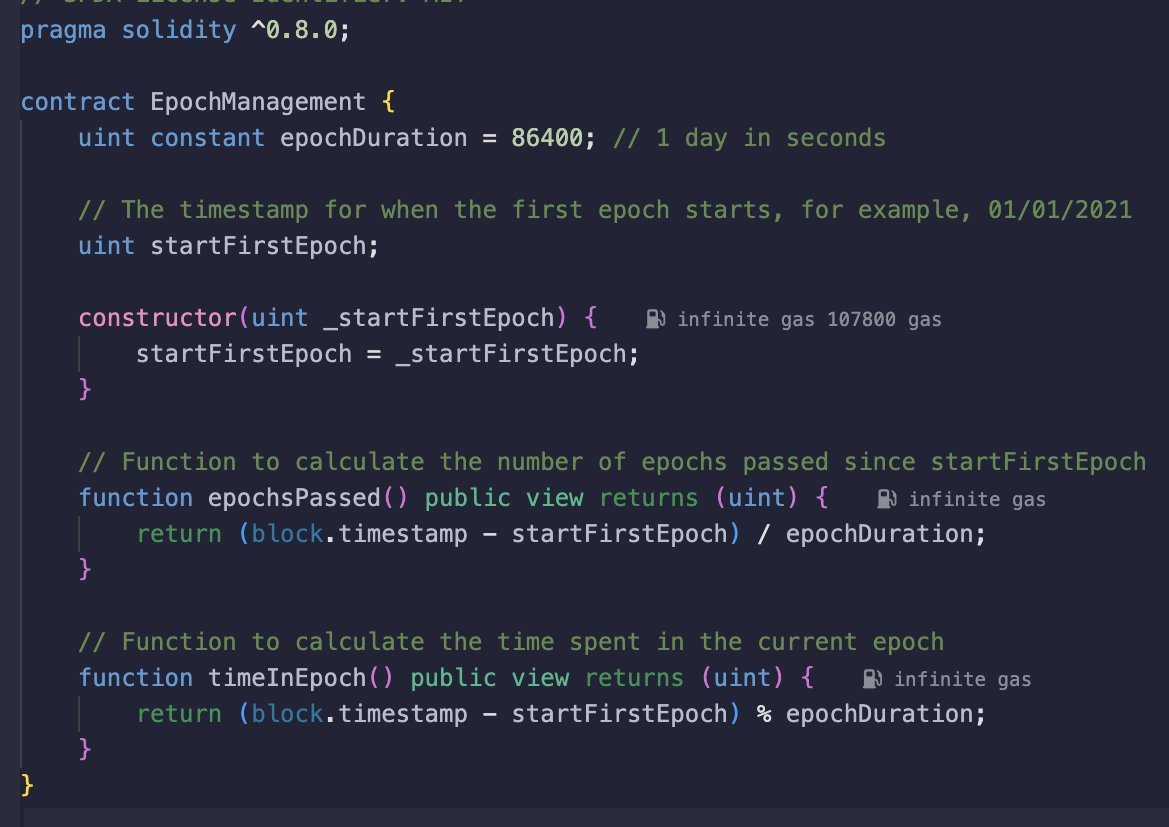
Epoch and time calculations are crucial forvarious applications, including those related to finance, gaming, and rewardmechanisms, where actions are triggered or determined based on specific timeintervals.
To understand the practicality of themodulo operator in the context of epochs, let's dissect a given example.
Epochs are predefined intervals of time. Inthe provided scenario, each epoch is defined as 86,400 seconds, whichtranslates into 1 day.
Assuming each epoch represents a day(86,400 seconds), the calculation method to determine the current epochinvolves dividing the time elapsed since the first epoch started by theduration of one epoch.
This can be expressed as (currentTime -startFirstEpoch) / epochTime.
The problem is now that solidity cannothandle floating numbers, hence it will always return one full epoch, not 1,5whatsoever.
Now to calculate the passed time in thecurrent epoch, the modulo operator comes into play.
By using currentTime % epochTime, theremainder from this division gives us the number of seconds that have passed inthe current epoch. This operation is particularly useful for determining whereexactly we are within an epoch, enabling smart contracts to executeepoch-specific logic, such as updating states, triggering events, orcalculating rewards based on the time within the current epoch.
So the next time you are auditing epochbased contracts, you are already one step ahead!