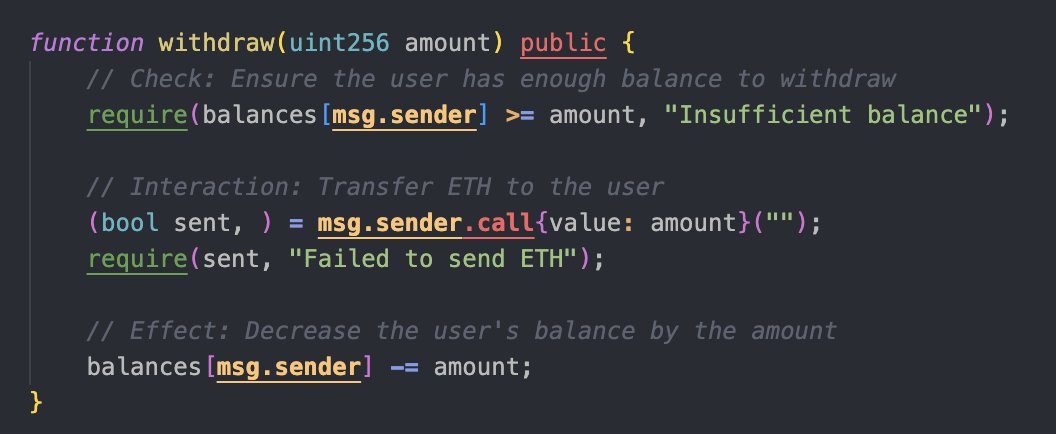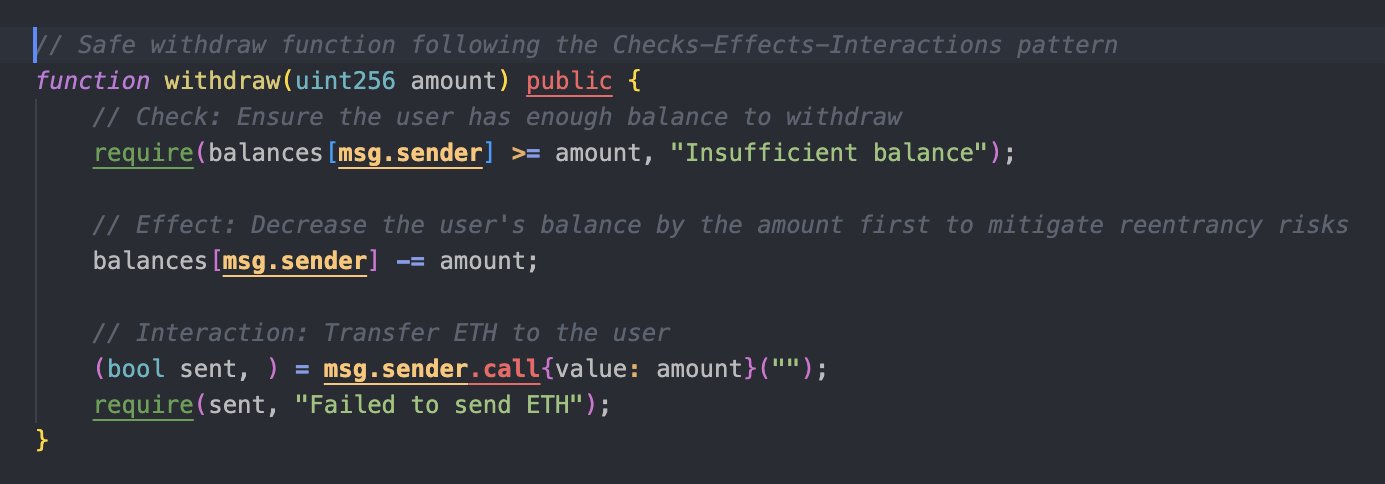
The most fundamental principle indeveloping smart contracts is the Checks-Effects-Interactions pattern. Thispattern isn't just a recommendation; the most essential corner of smartcontract, ensuring that contracts are not only more secure but also morepredictable and easier to reason about. While most developer know this pattern,there are still bugs in the wild due to that.
Today, let's delve into what this patternentails, its importance, and how adhering to it can shield your contracts fromcommon vulnerabilities, such as reentrancy attacks.
At its core, theChecks-Effects-Interactions pattern is a programming paradigm designed tominimize risks in smart contract execution.
It prescribes a specific order for writingfunction logic in Solidity contracts:
Checks: This initial step involvesvalidating conditions before executing any actions. It's about ensuring thatall prerequisites for a function to proceed are met. This could includeverifying user inputs, contract states, or any conditions that must be true forthe execution to continue safely. Using require(), assert() functions arecommon practices here to enforce these conditions.
Effects: After passing the checks, the nextstep is to adjust the contract's state. This involves the state variabletransition of the contract. It's crucial that these changes happen beforeinteracting with external contracts to prevent inconsistencies in thecontract's state, especially in the event of a reentrancy attack.
Interactions: The final phase involves thecontract communicating with external entities. This could be sending Ether toother addresses, calling functions of other contracts, or any actions thatreach outside the contract's immediate environment. By ensuring that this stepcomes last, the contract mitigates risks associated with external calls, whichcould potentially be malicious or behave in unexpected ways.
The Checks-Effects-Interactions pattern isnot just a good practice—it's a critical defense mechanism. Its importance ishighlighted when considering reentrancy vulnerabilities, a common attack vectorin smart contracts.
Imagine a scenario where a contract sendsEther to another address before updating its internal state to reflect thistransaction. A malicious actor can exploit this by designing their contract tore-enter the original function, effectively allowing them to withdraw fundsrepeatedly before the state is updated. This was famously exploited in the DAOattack, leading to significant losses.
By following theChecks-Effects-Interactions pattern, developers ensure that the contract'sstate is updated (Effects) before engaging in external interactions(Interactions).
This sequencing makes it significantlyharder for attackers to exploit the timing between state updates and externalcalls, thus safeguarding the contract from reentrancy attacks.