Automated Market Makers have set a newmilestone in facilitating token swaps without the need for traditional orderbooks. With the recent developments came the introduction of "hooks"into AMM pairs. But what exactly are these hooks, and why are they a novel andunique feature?
Currently, from what I know, @CryptoAlgebrais the only codebase which is already deployed, using hooks.
Before diving into hooks, let's brieflyrecap the core functionalities of AMM pairs:
Mint: This function allows users to provideliquidity to a pair, contributing to its reserves of two tokens. In return,users receive liquidity tokens, representing their share of the pool.
Burn: Liquidity providers can choose towithdraw their share of the pool by burning their liquidity tokens, receivingthe corresponding amount of the underlying assets back.
Swap: Users can trade one token for anotherwithin a pair, with the exchange rate determined by a mathematical formula thatensures the total value remains constant.
Introducing Hooks: Flexibility andAdaptability
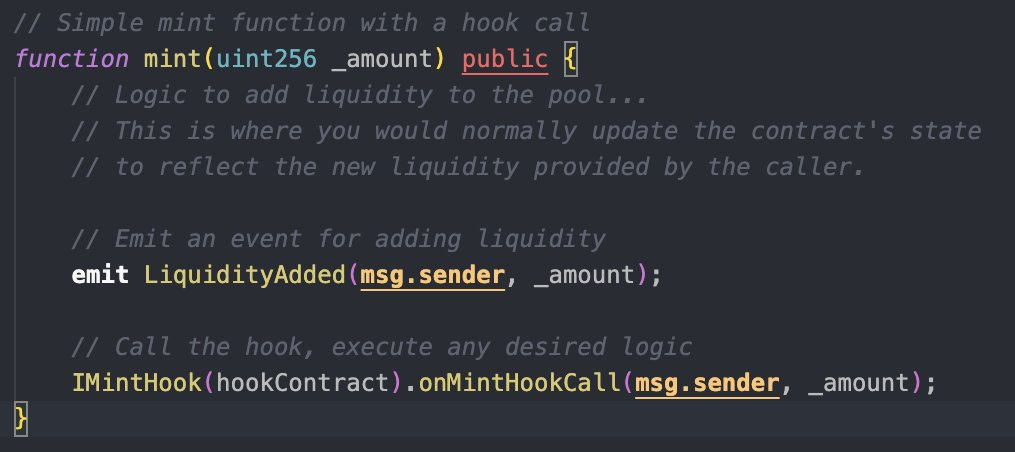
Hooks are essentially additional snippetsof code that are executed as part of the mint, burn, and swap functions. Theyallow these functions to trigger external contracts, executing arbitrary logicbeyond the basic AMM functionalities. This capability opens up a myriad ofpossibilities for enhancing the utility and flexibility of AMM pairs.
Example: Enhancing Mint with Hooks
Consider the mint function, whichtraditionally allows a user to add liquidity to a pool. With the introductionof hooks, this process can be extended to include steps like executing a KnowYour Customer (KYC) check through an external contract. This check could verifythe user's identity and eligibility to participate in the pool, adding a layerof security and compliance.
A critical aspect of implementing hooks isdetermining which external contracts are triggered and which hooks are active.
This decision-making process typicallyfalls under the purview of the platform's governance.
Through governance proposals and voting,the community can decide to modify the pair's storage to indicate which hookshould be activated and which external contract it should interact with.
The integration of hooks into AMM pairsrepresents a significant leap forward in making these liquidity pairs moreflexible. By enabling external calls within the core functionalities ofminting, burning, and swapping, developers can innovate on the fly, tailoringAMM pairs to meet evolving needs and regulatory requirements. Whether it'simplementing compliance checks, integrating with other DeFi protocols, orintroducing novel incentives for liquidity providers, hooks offer a powerfultool for customization.
This flexibility, however, also requirescareful governance and oversight to ensure that the added complexity does notcompromise security or user experience.